

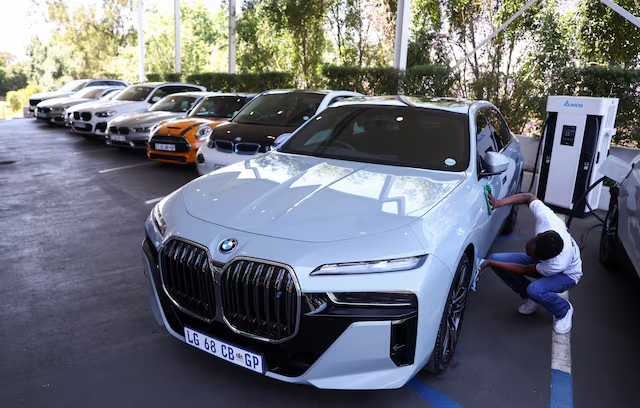
South Africa’s auto industry is not pushing for sharp increases in vehicle import duties. Instead, it is calling for precise, targeted adjustments to national auto policy to strengthen domestic manufacturing. This stance comes from BMW South Africa CEO Peter van Binsbergen, who spoke on Wednesday in response to recent parliamentary discussions about raising tariffs.
Earlier this week, the country’s international trade commissioner noted that South Africa imposes a 25% duty on imported vehicles—well below the 50% maximum allowed by the World Trade Organization (WTO). Deputy trade minister Zuko Godlimpi added that the government is reassessing whether to hike these tariffs.
However, van Binsbergen clarified that the industry does not support such a move. “Fifty percent is the bound rate within WTO,” he said. “I can tell you now, no one’s asking for that from the industry side. That must be very clear.” He emphasized that the commissioner was merely stating what’s legally possible—not advocating for it.
In fact, the industry prefers a more nuanced approach. “We’re looking for a fine-tuning of all the levers within APDP and not just one big hammer,” van Binsbergen explained. He was referring to the Automotive Production and Development Programme (APDP), South Africa’s key incentive scheme for local assembly and parts production.
He warned that jumping to the 50% tariff ceiling would “be a shock to the system.” Most critically, it would hurt consumers—especially those buying entry-level vehicles. “The worst being affordability for the entry-level consumer,” he said.
Meanwhile, BMW South Africa continues to lead the premium segment. Last year, the BMW brand captured 46.2% of the local premium market—up from 44.3% in 2024—despite rising affordability pressures and growing competition, including from Chinese automakers.
Additionally, BMW’s retail sales grew by 12% in 2025. Its Rosslyn plant produced over 79,000 vehicles—the highest output in its 52-year history. Looking ahead, the company plans to launch the BMW iX3 in South Africa in the second half of 2026. This model marks the debut of BMW’s all-electric “Neue Klasse” series in the country.
Notably, BMW already holds a 22% share of South Africa’s battery electric vehicle (BEV) segment. This positions the brand as a leader in the early stages of the country’s EV transition.
In summary, the South Africa auto industry is prioritizing smart policy over protectionist tariffs. By refining incentives like the APDP—and avoiding blunt measures like steep duty hikes—it aims to build a competitive, sustainable manufacturing base that serves both producers and consumers.
READ: AT&T Forecasts Strong Profit on Fiber and 5G Expansion

