

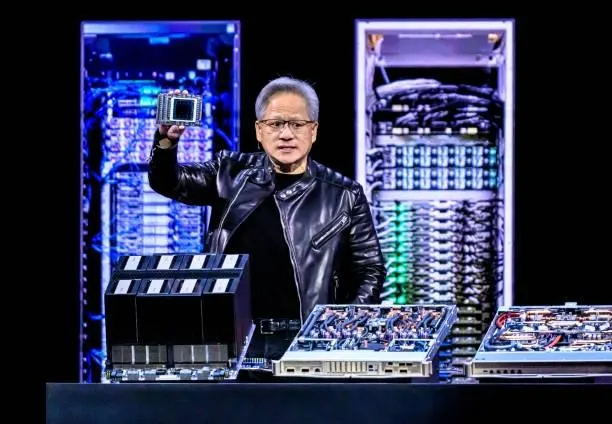
The Nvidia AI infrastructure position has transformed from market leader to essential global technology backbone. Indeed, Wall Street now treats Nvidia’s remarkable growth as routine rather than exceptional.
Specifically, Nvidia reports fourth-quarter revenue expectations near $65.5 billion in 2026. Consequently, this represents a 67 percent year-over-year increase that investors barely notice. Moreover, the company has beaten analyst estimates in 20 of the past 22 quarters.
The Nvidia AI infrastructure dominance reflects a fundamental market reclassification. Indeed, Nvidia has stopped merely competing and now actively shapes the entire AI ecosystem. This shift brings unique pressures alongside extraordinary opportunities.
Hyperscaler spending reveals the true scale of dependency. Specifically, Meta raised capital expenditure guidance to $135 billion while Alphabet committed $185 billion. Furthermore, Amazon plans $200 billion in infrastructure investment for 2026.
Combined hyperscaler spending now approaches $700 billion globally. Consequently, this mirrors Nvidia’s own revenue growth rate almost exactly. Therefore, this correlation represents a clear dependency map rather than coincidence.
Nvidia holds an estimated 75 to 90 percent market share in AI accelerators. Thus, the company functions as far more than a simple supplier. Indeed, Nvidia AI infrastructure has become the essential chokepoint for the largest technology buildout in history.
The bottleneck extends deeper than software alone. Specifically, Nvidia reportedly secured over 60 percent of TSMC’s advanced packaging capacity through 2027. Additionally, SK Hynix confirmed its entire 2026 high-bandwidth memory supply is sold out.
Google reportedly reduced its 2026 TPU production target from 4 million to 3 million units. Consequently, this cut resulted from insufficient packaging slots rather than demand issues. Thus, the physical supply chain beneath Nvidia’s chips represents its own critical constraint.
Nvidia did not intentionally become foundational infrastructure. Indeed, the company simply built superior AI chips while demand exploded beyond existing pipeline capacity. Furthermore, competitors now redesign systems specifically to reduce dependence on Nvidia.
Governments increasingly treat Nvidia as strategic leverage rather than ordinary market participant. Consequently, the company crossed from category leader to non-optional layer faster than any predecessor. This transition brings distinctive internal pressures alongside external success.
Historical patterns illuminate this trajectory clearly. Railroads created steel empires beyond moving people. Energy systems reshaped geopolitics beyond fueling factories. Similarly, cloud computing rewarded infrastructure providers long before software economics stabilized.
The Nvidia AI infrastructure position attracts unique competitive responses. Specifically, rivals attempt to remove dependency entirely rather than simply building better alternatives. This represents competition by necessity rather than opportunity.
Google developed TPUs optimized for its internal JAX framework historically. Consequently, these chips struggled to attract developers already committed to PyTorch and CUDA. Indeed, Nvidia’s software ecosystem formed its deepest competitive moat for nearly two decades.
That dynamic now shifts meaningfully. Specifically, Google accelerated TorchTPU development to enable native PyTorch compatibility without CUDA. Furthermore, Meta actively collaborates on improving this compatibility as one of Nvidia’s largest customers.
Google and Meta pursue TorchTPU not to out-chip Nvidia directly. Instead, they seek to eliminate the need for Nvidia entirely. Therefore, this dependency-risk competition proves far harder to defend against than traditional performance rivalry.
Infrastructure dominance triggers strategic asset classification at scale. Specifically, Nvidia AI infrastructure decisions increasingly resemble foreign policy rather than corporate strategy. Consequently, export controls and geopolitical tensions directly impact business performance.
Nvidia’s China exposure illustrates this reality painfully. Indeed, even after the U.S. lifted H20 chip export restrictions in mid-2025, sales barely recovered. Specifically, CFO Colette Kress projected $2 billion to $5 billion in potential H20 revenue if tensions eased.
The actual result last quarter totaled only $50 million. Consequently, sizable purchase orders never materialized despite the policy change. Thus, trust damage persisted independently of regulatory adjustments.
Nvidia’s stock increasingly reacts to export-control headlines as much as product announcements. Indeed, when chips underpin economic growth and national security, distribution decisions transcend ordinary corporate strategy. Therefore, this represents the inherent price of becoming unavoidable.
Wednesday’s earnings report will almost certainly show strong results. However, the more significant indicator lies in Q1 FY2027 guidance. Specifically, consensus expectations exceed $65 billion in quarterly revenue for Nvidia AI infrastructure.
This figure exceeds annual revenue for most public companies. Consequently, such scale demonstrates what non-optional status looks like in financial terms. Indeed, infrastructure dominance concentrates value at the foundational layer first.
Any company operating at AI’s foundational layer faces similar structural questions. Specifically, advanced packaging, high-bandwidth memory, and semiconductor manufacturing all approach critical chokepoint status. Therefore, dependency, pricing power, and leverage emerge at these essential layers.
Durable returns flow to layers remaining essential regardless of application winners. Consequently, measuring the right risks matters profoundly for infrastructure companies. Indeed, the danger lies not in customers stopping purchases but in rules changing unexpectedly.
Export controls, supply-chain intervention, and regulatory capture multiply exposure invisibly. Thus, growth can remain strong while systemic risks accumulate beyond standard earnings models. Therefore, Nvidia AI infrastructure success demands sophisticated risk assessment beyond traditional metrics.
The gold rush principle applies consistently across technological revolutions. Specifically, infrastructure providers get paid first while applications compete later. Consequently, foundational layers capture disproportionate value during buildout phases.
Nvidia’s trajectory offers a template for identifying future non-optional layers. Indeed, companies supplying essential components to ubiquitous systems often outperform application developers long-term. Thus, recognizing structural dependencies creates strategic investment advantages.
The Nvidia AI infrastructure story continues evolving rapidly in 2026. Specifically, hyperscaler spending patterns, supply chain constraints, and geopolitical tensions all shape outcomes. Consequently, stakeholders must monitor multiple dimensions beyond quarterly earnings alone.
Ultimately, infrastructure dominance creates both extraordinary opportunity and unique vulnerability. Indeed, the better Nvidia performs, the harder others work to reduce dependency. Therefore, sustainable leadership requires continuous innovation alongside strategic relationship management.
The Nvidia AI infrastructure position exemplifies how technological excellence can transform market dynamics fundamentally. Consequently, understanding this transition helps anticipate similar shifts across emerging technology sectors in our interconnected global economy.
READ: Bill Gates Addresses Staff Over Epstein Files and Past Personal Affairs